Thomas Bennet
Just DesertsThomas Bennet is the father of five daughters and the owner of Longbourn, but his most consequential characteristic is the contradiction between private affection and public negligence. He loves Elizabeth Bennet and recognizes her intelligence, yet his preference for books, port, and quiet withdrawal prevents him from protecting her from the household conditions that make her leave. His belated remorse gives the character moral complexity without undoing the central fact of his failure: he sees the harm only after his inaction has helped make it permanent.
Identity and Family Position
Thomas Bennet is presented through Elizabeth Bennet’s childhood as the one parent who gave her consistent affection. She was his most academically gifted daughter, and their shared interest in books and her curiosity about the world created a bond that contrasted sharply with her difficult relationship with Mrs. Bennet. From the age of five until she was fourteen, Elizabeth treated her father as the most important person in her life and even idolized him largely because he enjoyed spending time with her.
That intimacy is real, but it is also limited. Thomas Bennet tolerates Elizabeth partly because she shares his love of reading, while his wife, daughters, and estate remain secondary to solitary intellectual pleasure and port. Elizabeth’s growing maturity therefore changes not her love for him but her respect. She comes to see that the father she had placed on a pedestal is lazy, performs only the minimum required across much of his life, and has made withdrawal into his book room a substitute for family responsibility.
His position as master of Longbourn gives that idleness practical consequences. He has authority over Elizabeth even after she reaches legal adulthood because she remains at home, and his decisions affect both her freedom and the financial future of the family. The entail makes Longbourn especially important: for much of the narrative, the estate is expected to pass through a male succession that places the family’s daughters in a vulnerable position.
Affection Versus Neglect
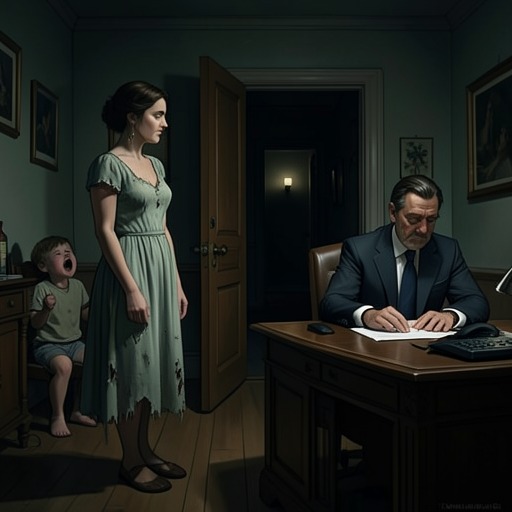
Thomas Bennet’s marriage and domestic conduct teach Elizabeth a lesson he never intends to give her. She can infer that he and Mrs. Bennet once loved one another, but the marriage she witnesses has become a failed partnership. His wife’s shrill complaints and repeated attacks on Elizabeth are not balanced by any effective intervention from him. Instead, he retreats to his books and port while Mrs. Bennet’s behavior goes unchecked.
Elizabeth’s time with Sir David Pentland and Lady Radha Pentland sharpens this judgment. Their long marriage shows her that an older couple can combine activity, calmness, and mutual respect. The contrast makes Longbourn’s atmosphere appear not merely unpleasant but structurally damaging. Thomas Bennet’s passivity is part of the problem because it leaves Elizabeth without a sanctuary of her own. His love is emotionally meaningful to her, but it does not become an active duty toward her welfare.
The pattern becomes unmistakable after Jane Bennet’s illness and return from Netherfield Park. Mrs. Bennet blames Elizabeth for the loss of a matrimonial opportunity, while Thomas Bennet announces, with only four hours’ notice, that the heir to Longbourn, William Collins, has invited himself to stay. His failure to manage either the household crisis or his wife’s conduct reinforces Elizabeth’s belief that he uses intelligence as an escape rather than as a basis for action.
The Decision That Drives Elizabeth Away
Thomas Bennet’s most damaging exercise of authority comes after Elizabeth has decided to leave Longbourn and join Edward Gardiner and Madeline Gardiner in London. Although Elizabeth is approaching adulthood, she still seeks permission because she lives under her father’s authority. He refuses to let her return to London after Twelfth Night and forces her to remain at Longbourn for an additional fifteen days, despite the daily verbal abuse she receives from Mrs. Bennet.
To Thomas Bennet, keeping Elizabeth at home is connected with her twenty-first birthday and may be intended as a loving family gesture. To Elizabeth, it is an arbitrary use of power that extends her exposure to a harmful environment. Sir David Pentland has taught her that beatings need not be physical: the bruises left by Mrs. Bennet exist in her psyche rather than on her skin, but they are still bruises. Thomas Bennet’s failure to act makes him part of the conditions producing them.
Elizabeth’s departure follows. She writes notes of love and explanation to Jane Bennet and Mary Bennet, but her note to Thomas Bennet takes five attempts because she cannot keep her bitterness from entering the words. Once she leaves for London, Thomas Bennet understands that the separation is likely permanent. In his study he looks at the chair where Elizabeth used to sit and realizes that his hiding among his books, while his wife went unchecked through the rest of the house, helped bring about her departure. His grief is genuine, but it arrives after the decision can no longer be reversed.
Longbourn, Authority, and Consequences
Elizabeth’s absence exposes how much practical work she had been doing. Jane Bennet, Mary Bennet, and sometimes Kitty Bennet continue visiting the tenants, while Thomas Bennet becomes an even more indolent master of the estate. Mrs. Bennet spends freely and excessively while worrying about the possibility of poverty after her husband’s death, and Thomas Bennet does little to counter either the spending or the neglect. His authority exists formally, but his administration is weak enough that the family’s future remains precarious.
The letters exchanged after Elizabeth reaches Gracechurch Street reveal the emotional shape of the rupture. Jane Bennet, Mary Bennet, and Kitty Bennet write with love and accept that Elizabeth may never return. Thomas Bennet writes no demands; he simply says that he is sorry the situation has come to this and places much of the blame on himself. Elizabeth appreciates the admission emotionally, but she knows intellectually that nothing at Longbourn will change. His apology acknowledges responsibility without demonstrating the sustained action that might have prevented the crisis.
When Netherfield Park is let again, Thomas Bennet receives the news with resigned awareness that another disturbance is coming to Hertfordshire. Later, during Lydia Bennet’s crisis, he must finally act in a more decisive public role. After Lydia’s attempted elopement with Lieutenant Denny, Thomas Bennet is summoned with Colonel Foster to the Militia headquarters, where he learns that Lieutenant Denny has proposed marriage to Lydia but will require a sufficient inducement. He recounts the meeting to Jane Bennet and Mary Bennet in a controlled account, asking them to hear the story without interruptions. The episode shows that he can respond when circumstances become unavoidable, but it also underlines how rarely he has chosen such engagement within his own household.
Estate Settlement and Final Fate
The legal future of Longbourn changes after William Collins dies of a fever at an inn in Pepperstock on December 4, 1812. Thomas Bennet joins Edward Gardiner, Philips, Sir William Lucas, and Clive Bredason in tracing the Bennet family line through legal documents, parish records, and the Bennet Family Bible. They establish that no male heir remains in any line descending from Martin Bennet and that the entail is therefore broken.
This finding restores Thomas Bennet’s power to dispose of Longbourn. He may leave the estate to any child, divide it among his children, or sell it. The legal release is significant because the entail had long turned his daughters’ security into a matter of male succession and marriage. Yet the freedom arrives after years of mismanagement and after Elizabeth has built a separate life.
Elizabeth proposes that Longbourn be sold to expand Grenadine Reef. Using a comparable purchase as a working estimate, she calculates a price of £100,000 for the estate’s 2,000 acres. Jane Bennet, Mary Bennet, and Catherine Bennet would each receive a £25,000 dowry, while the remaining £25,000 would provide Thomas Bennet with a principal capable of producing the £2,000 annual income he currently has. Thomas Bennet and Fanny Bennet would retain a life tenancy in Longbourn manor, while the land would be added to Grenadine Reef. The arrangement returns responsibility for the dowries to Thomas Bennet, protects his later comfort, and places the estate under more effective management.
Thomas Bennet is happy to sell Longbourn, but the sale does not restore his relationship with Elizabeth. In the years that follow, he drinks himself into an early grave. Elizabeth thinks of him mainly through the practical example of Edward Gardiner, whose family is secure and well cared for, rather than through renewed filial attachment. His final legacy is consequently double-edged: he was the parent who loved Elizabeth most openly, yet his refusal to convert love into responsibility helped drive her away, weakened Longbourn, and left him with remorse instead of reconciliation.